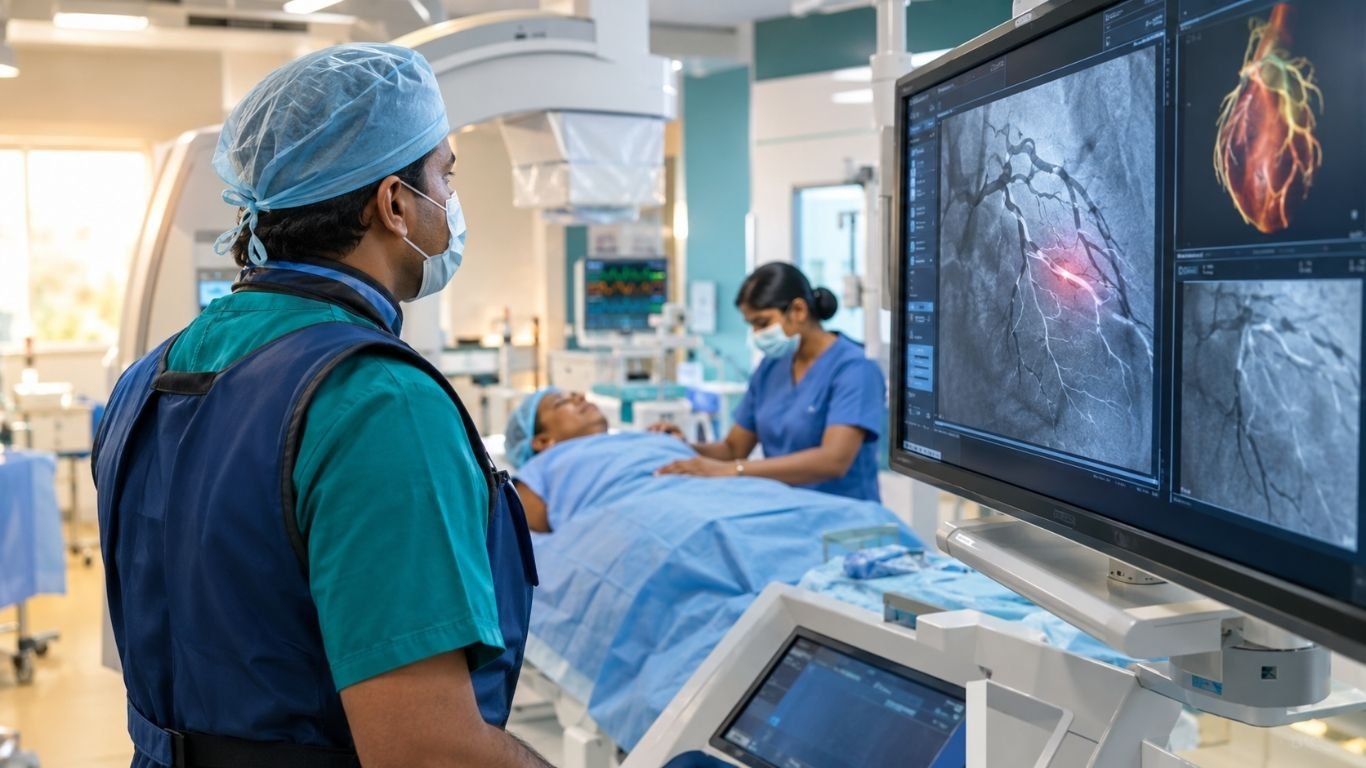
A sense of heaviness in the chest while going up the stairs. A strange pain traveling from the chest into the left arm after eating. We all tend to disregard such moments, but they may very well be an indication of the narrowing of a heart artery. If your doctor has said anything about a blockage, then angioplasty in Tirur may be considered as a treatment option not far from where you live, without the long trip to a bigger city.
The article will give a clear explanation of when angioplasty is required, the process of carrying out the procedure, what recovery entails and what to ask your cardiologist.
The simple answer is that angioplasty is a minimal invasive procedure that uses a balloon to open a narrowed or blocked heart artery, often accompanied by stenting. The procedure is mostly required during a heart attack or when a blockage leads to chest pain that is not manageable with medication alone.
What Is Angioplasty and How Does It Work?
Coronary angioplasty (PTCA – percutaneous transluminal coronary angioplasty) dilates a blocked coronary artery to allow fresh blood supply to the heart muscles.
A physician inserts a flexible catheter into an artery in the wrist or groin, and then maneuvers it till it reaches the area of the blockage. Then a balloon attached to its tip inflates and squeezes the fatty deposits away from the inner wall of the vessel. Most often a stent – a miniature metallic mesh tube with drug coating is inserted to keep the vessel open.
One can imagine a water hose with a kink in it. The balloon untwists it, and the stent prevents it from collapsing again. The operation requires only a very small hole to be made and no cutting of the chest open.
When Is Angioplasty Needed?
Short answer: Angioplasty is advised in case of a heart attack, unstable angina, and stable angina associated with a substantial blockage, even after medications.
During a Heart Attack
Heart attack occurs due to a sudden formation of clot and blocking of a coronary artery that results in decreased flow of oxygen-rich blood in the heart muscle. Primary angioplasty opens up the blocked coronary artery and is considered to be the most effective method of treatment as long as it is performed promptly. Timing is critical, which explains why immediate access to cath lab 24 hours a day is essential, and why people think about angioplasty in Tirur even before the crisis.
For Angina and Tight Blockages
When you have recurring chest pain while exerting yourself or tight narrowing as detected in stress test or coronary angiography, angioplasty will relieve your symptoms and improve your activity. However, all blockages do not require stenting, only the more severe ones do. Mild and moderate narrowings may be treated successfully using medication and modification of life style alone.
Which Warning Signs Should You Never Ignore?
Short answer: You need immediate attention if you are experiencing any chest pain, pressure or heaviness, particularly if it extends to your arm, jaw or back.
- Pain in chest that is described as squeezing, pressure or burning sensation
- Pain traveling into your left arm, shoulder, neck, jaw or back
- Shortness of breath, cold sweat, nausea or dizziness
- Exhaustion following minimal exertion
Patients with diabetes, female and elderly patients may experience mild chest pain. Shortness of breath or exhaustion may be the only indication. Don’t hesitate if the symptoms are intense or persist for a number of minutes. Don’t drive yourself; call an ambulance and go to the hospital equipped with cardiac emergencies facilities and cath lab.
Angioplasty or Bypass Surgery: How Is the Choice Made?
Short answer: It is all dependent on the number of arteries that are clogged, the location of clogs, pumping function of the heart, and presence of any other diseases including diabetes.
If there are only one or two clogs and the placement allows stenting, then an angioplasty might be more appropriate; however, several severe clogs, the left main artery clog or reduced pumping capacity might call for a bypass surgery. Your cardiologist will discuss both procedures with you based on your angiogram.
What Happens Before, During and After Angioplasty in Tirur?
This is what normally happens. Your own process may vary a little:
- Discussion and preliminary testing. ECG, echocardiogram and blood tests check how your heart is functioning.
- Angiography. Special dye is introduced through catheters to make your coronary vessels visible on X-rays and to identify the blockages.
- Planning and signing a consent form. If there is a need for treating a blockage, the doctor discusses possible ways of doing it and possible complications with you. Sometimes, the angioplasty is done at once after the diagnosis is made, if you agree.
- Angioplasty itself. Under local anaesthetic and mild sedation the balloon and the stent are implanted. A routine angioplasty takes from 30 minutes to 1 hour.
- Observation. You are being observed for heart rhythm, blood pressure and condition of the puncture wound.
- Discharge. A patient discharged from hospital in 1–3 days.
You feel pressure, warmth from the dye, but no pain. The whole procedure is explained to you step by step.
How Long Does Recovery Take?
Short answer: People resume light activities in a matter of days and office work in one week. The schedule of recovery is set by your cardiologist.
Don’t do any lifting of heavy weights or physical exercises until you get an okay from your doctor. The most crucial thing is the medication. You will be prescribed aspirin and a secondary blood thinner to prevent clots. You shouldn’t miss any doses because they can cause formation of blood clots inside the stent.
The stent resolves only one occlusion. The stent doesn’t cure the disease. Protection from future heart attacks lies in regular healthy behavior:
- Make daily walks gradually increasing their intensity
- Reduce intake of fried foods, too much salt, sugar, and red meat
- Get rid of smoking completely
- Maintain normal levels of glucose, blood pressure and cholesterol
- Visit all your checkups and find out more about cardiac rehabilitation
Anybody who undergoes an angioplasty procedure in Tirur or elsewhere needs to regard it as a new beginning.
What Are the Risks of Angioplasty?
An angioplasty is a common and relatively safe procedure; however, there is always some level of danger associated with any procedure. The most frequent complication is bruising and/or slight bleeding from the point where the catheter was inserted. Other possible complications include an allergic reaction to the contrast dye, strain on the kidneys, and narrowing of the artery.
The probability of each of these complications occurring depends on your age, kidney function, diabetes, and the urgency of the procedure. Make sure that your cardiologist discusses your individual risk factors prior to signing the consent form. Any angioplasty team at Tirur will be more than happy to do this.
Why Consider Angioplasty in Tirur at Tirur Nursing Home?
Tirur Nursing Home is situated on Hospital Road, in the center of the town. The cardiology department of this nursing home offers treatment ranging from preventive measures to cure. These factors need to be considered if you are looking for an option for angioplasty in Tirur:
- 24-hour emergency services and cath lab – This is all a heart attack requires.
- Cardiology intervention services including Dr. Mohamed Iliyas (DM Cardiology), who specializes in interventional cardiology.
- Diagnostics available on-site, including laboratory and radiological diagnostics. No need to go around different buildings.
- Effective communication. One family expressed how the doctors explained each and every process to them before performing angioplasty on their father.
Final Thoughts: Is Angioplasty in Tirur Right for You?
The procedure involves reopening the heart’s blocked blood vessels. Having an idea of the signs to look out for, the process involved and what the treatment requires is much easier. In case you experience chest pain, shortness of breath, have a medical history of heart diseases, or have an abnormal test result, then don’t wait until you face a problem. You can find angioplasty in Tirur in Tirur Nursing Home where the cardiology department will assess your results and advice on whether you require treatment, medication or just monitoring.
Are you ready for your next appointment? Make your cardiology appointment or contact the hospital helpline on [insert telephone number] or visit the cardiology section of tirurnursinghome.com.
FAQs
When is angioplasty needed?
This is something that can only be diagnosed by a cardiologist. Doctors advise to undergo this treatment after heart attacks and in case of significant blocks detected in ECG, stress tests and coronary angiography that cause symptoms despite drug treatment. If you suffer from chest pain, difficulty breathing and strange fatigue, a consultation is what you need.
Is there any pain during an angioplasty and how long does it last?
The procedure is carried out under local anesthesia and so you will feel pressure but not sharp pains; a mild sedation will help you relax. A typical angioplasty takes about 30 to 60 minutes but sometimes takes more time. For a couple of days after this treatment you will probably feel discomfort in the place of puncture in your wrist or groin.
What is the period of hospitalization after angioplasty?
After a scheduled angioplasty a patient stays in the hospital for 1 to 3 days depending on his/her condition and the outcome of the procedure. Patients who had a heart attack should stay in the hospital longer; quite often it includes a stay in the cardiological intensive care unit.
Is there a chance of the blockage coming back after the stenting procedure?
Yes, there is. The stent could become narrower, and fresh blockages might arise at other places if the risks remain unmanaged. Having antiplatelet medication as prescribed, not smoking, controlling blood sugar levels, blood pressure, cholesterol levels, exercising regularly and going for follow-ups will decrease the chances of this happening.
How much does angioplasty in Tirur cost?
The price of the angioplasty procedure in Tirur is determined by the number and kind of stents used, the room category, the length of stay and the insurance coverage you have. Since no two cases are the same, the most reasonable way would be to ask for a detailed estimate after your cardiologist examines your angiogram.